
Select a section
History of the Swamp Mine
From an early feldspar quarry to one of the world’s best-known uraninite localities
The Topsham Feldspar Industry — Mid-1800s
The history of Swamp Mine begins with the much larger story of feldspar mining in the Topsham–Bowdoinham area of Maine.
In a Maine Geological Survey report based on fieldwork conducted in 1945, geologist Vincent E. Shainin wrote that the Topsham area had been producing feldspar for nearly a century. Commercial feldspar production in the district therefore appears to have begun around the middle of the 1800s.
The district became one of New England’s early feldspar-producing regions. Its location was favorable because Topsham was close enough to navigable water for feldspar to be shipped economically to ceramic manufacturers along the Atlantic coast, particularly the pottery industry around Trenton, New Jersey.
The productive pegmatite belt extended for approximately eight miles, from the Androscoggin River at Topsham north-northeast toward Bowdoinham. Numerous quarries were eventually opened within this belt.
It was within this mining district that the small quarry later known as Swamp Mine developed.
The Swamp Quarry — Early 1900s
By the late 1800s and early 1900s, numerous pegmatite bodies around Topsham had been opened for feldspar.
Mining was relatively simple by modern standards. Workers drilled and blasted the pegmatite, broke apart the rock and hand-sorted the material. Commercial feldspar was separated from quartz, mica, garnet and other minerals. Potash feldspar suitable for ceramics was an important product, and graphic granite—an intergrowth of quartz and feldspar—was also mined.
Swamp Mine appears to have originated during this period. Although feldspar mining in the Topsham district began much earlier, historical accounts describe Swamp as a very small early-1900s feldspar quarry.
The quarry was not opened to mine uranium. Uraninite was simply one of the accessory minerals occurring within the pegmatite.
That distinction would become important many years later.
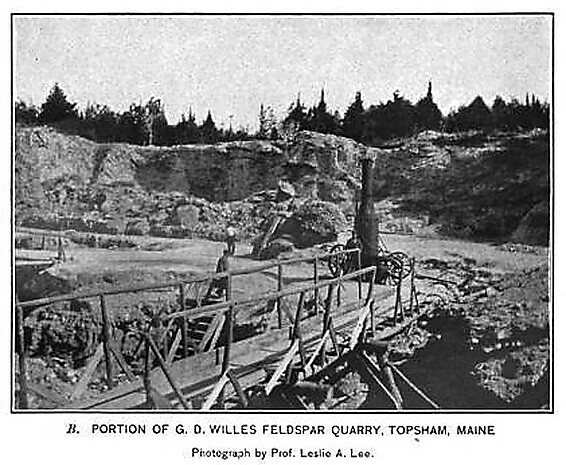
Willes Feldspar Quarry — early 1900's

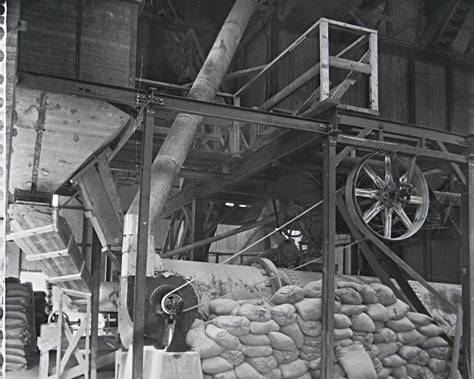
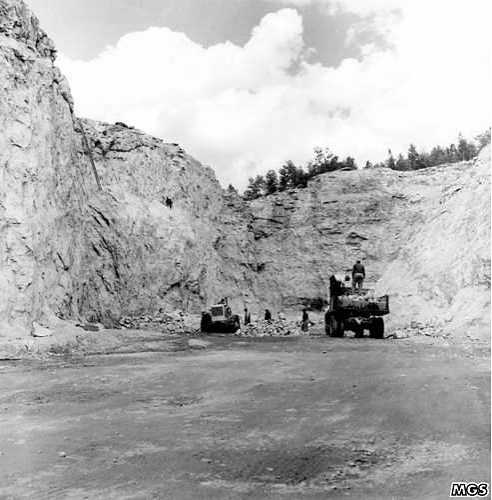
The quarry covered several acres and was about 50 feet deep. Mining took place on several levels. Workers drilled by hand and used black powder for blasting. A tramway carried waste rock to the dumps and feldspar to the stock sheds.[2] This is not Swamp Mine, which lies about 1.8 miles away.
Abandonment and Flooding — 1920s–1940s
As easily worked portions of the pegmatites were exhausted and the economics of feldspar production changed, many of the smaller Topsham quarries were abandoned.
By World War II, some mining operations in the district were extremely small. Shainin reported that wartime mining was conducted sporadically by crews of only one to three men, producing relatively small quantities of feldspar for sale to the Consolidated Feldspar Company.
Mining was selective. Workers concentrated on the best feldspar exposed in a pegmatite and moved elsewhere when the high-grade material was exhausted.
Abandoned quarries frequently filled with groundwater and rainwater. By the 1940s, Shainin noted that many previously worked pegmatites in the Topsham district were already flooded or backfilled.
This flooding would later become part of the Swamp Mine story.
The Geological Survey — 1945–1948
In 1945, the Maine Geological Survey and U.S. Geological Survey conducted a three-month cooperative investigation of the Topsham pegmatite district. The primary purpose was economic: to study the feldspar deposits and evaluate their potential for future production.
Vincent E. Shainin published the results in 1948 as Maine Geological Survey Bulletin 5, Economic Geology of Some Pegmatites in Topsham, Maine. The report included descriptions, illustrations and a geologic map of the district.
Importantly, the pegmatite containing what later became known as Swamp Mine was mapped during this work.
At the time, however, Swamp Mine was still simply an old feldspar quarry. The remarkable uraninite crystals that would eventually make the locality famous had not yet attracted widespread attention.
Cliff Trebilcock’s Discovery — About 1958
The history of Swamp Mine changed dramatically around 1958.
Clifford “Cliff” Trebilcock Jr., a young mineral collector from Topsham, discovered exceptional uraninite crystals at the old quarry when he was about 13 years old.
The quarry was subsequently drained, and Trebilcock and his parents recovered unusually fine uraninite crystals from the locality.
What made the material remarkable was its crystal quality. Uraninite commonly occurs as massive or irregular material, but the Swamp Mine produced sharp, jet-black crystals with brilliant luster and well-developed faces. Some occurred as individual crystals, while others formed complex groups. Cubo-octahedral forms were particularly striking.
Specimens from these early Trebilcock discoveries eventually entered important private and institutional mineral collections. Documented examples include lustrous cubo-octahedral crystals approaching a centimeter in size.
An obscure abandoned feldspar quarry had become the source of extraordinary mineral specimens.
The Secret Locality
For many years, Trebilcock apparently did not publicly reveal exactly where his uraninite crystals were being found.
Collectors knew that exceptional uraninite was coming from somewhere in the Topsham area, but the district contained numerous pegmatites, quarries and abandoned pits. According to later historical accounts, Trebilcock kept the precise location confidential, making it difficult for other collectors to identify his source.
This helps explain why older specimens and publications may identify the locality simply as Topsham, Maine, the Trebilcock locality, or the Trebilcock pit, rather than Swamp Mine.
The mystery surrounding the source became part of the history of the crystals themselves.
Swamp Mine Becomes a Classic Uraninite Locality
Beginning with the Trebilcock discoveries, Swamp Mine uraninite gradually acquired an exceptional reputation among mineral collectors.
The locality is particularly notable for the combination of crystal form, sharp edges, brilliant black luster and unusually fine surface quality. Although large uraninite crystals occur elsewhere in the world, the quality of the best Swamp specimens made the locality especially important to collectors.
Two adjacent workings are generally known as Swamp Quarry #1 and Swamp Quarry #2. They are separated by a narrow roadway but were excavated in the same pegmatite body. Swamp Quarry #1 proved considerably more productive, although high-quality uraninite occurred in both workings.
The original purpose of both quarries remained the same: the commercial extraction of feldspar, not uranium.
Ironically, the mineral that would eventually make Swamp Mine famous had little commercial value to the people who originally worked the quarry.
The Locality Becomes Public — 1994
An important change occurred in 1994 with the publication of Vandall T. King and Eugene E. Foord’s Mineralogy of Maine, Volume 1: Descriptive Mineralogy by the Maine Geological Survey.
The work documented a substantial suite of minerals from Swamp Mine, including uraninite. Other reported minerals include albite, allanite, garnet, biotite, columbite-(Fe), ishikawaite, magnetite, microcline, monazite-(Ce), muscovite, nontronite, pyrite, quartz, smoky quartz and zircon.
A later historical account identifies publication of this work as the point at which Trebilcock’s long-protected source became publicly identified as Swamp Mine.
The year 1994 therefore marks an important transition: the semi-secret Trebilcock locality had become a publicly documented mineral locality.
Trebilcock Returns — 1996
Nearly four decades after his original discovery, Cliff Trebilcock returned to Swamp Mine in 1996 with Don Swenson to prospect again for uraninite.
Uraninite could still be found.
A documented account from this period describes searching old quartz and feldspar dump material with a Geiger counter. Radioactive pieces of feldspar could then be broken apart to expose uraninite crystals within the rock.
This provides an important clue to how some of the later Swamp crystals were recovered. They did not necessarily come from newly mined rock in the quarry wall. Instead, collectors could search the waste-rock dumps left behind by feldspar miners decades earlier.
To the original commercial miners, a small black uraninite crystal embedded in feldspar had little economic significance. The surrounding rock might simply be discarded on the dump.
To a mineral collector many decades later, the same piece of rock could contain an exceptional specimen.
Scientific Study of the Uraninite
Swamp Mine uraninite is interesting scientifically as well as aesthetically.
Uraninite is primarily uranium oxide and contains a very high percentage of uranium by weight. Over geological time, radioactive decay changes the composition of the mineral and produces radiogenic lead.
A 1997 study published in The Canadian Mineralogist analyzed uraninite from several New England pegmatites. Swamp Mine uraninite contained approximately 2.5 weight percent PbO, with the lead interpreted as radiogenic. The reported lead-isotope relationship indicated an age of approximately 312 million years.
This creates two very different time scales in the history of Swamp Mine. Its human history encompasses roughly a century and a half of mining, collecting and scientific study. Its geological history reaches back more than 300 million years.
Learn more: The 312-Million-Year-Old Uraninite of Swamp Quarry
From Private Collections to Museums
As the reputation of Swamp Mine grew, specimens from the locality became widely dispersed.
Some of the original Trebilcock specimens entered prominent private collections. Others changed hands through the mineral market, where a documented connection to the early Trebilcock finds became an important part of their provenance.
Major institutional collections also acquired Swamp Mine material. Harvard’s Mineralogical & Geological Museum has identified notable Swamp Mine uraninite among the radioactive minerals in its collection.
Photographed and documented specimens demonstrate the exceptional quality the locality could produce. Some crystals exceed a centimeter in size, and unusually large specimens have been reported. Such large examples, however, are not representative of the typical Swamp Mine crystal.
Today, many of the finest specimens are preserved in museums and private mineral collections.
2005 — Radiation Survey
In 2005, a reconnaissance radiation survey was conducted at the Swamp Quarry spoil pile.[5]
Background radiation away from the pile was approximately 20 counts per minute (CPM), while measurements within the dump were commonly much higher. Readings of several hundred CPM were recorded at numerous locations, and a small uraninite-bearing rock produced readings as high as 5,000 CPM.
The report concluded that radiation levels were high enough to warrant evaluation by health physicists to determine potential radiation doses to visitors. The survey specifically considered people spending time on the spoil pile, including mineral collectors and children playing close to the ground.
The measurements demonstrated that radioactive material was not confined to museum specimens or isolated crystals. Uraninite remained distributed through portions of the old quarry dump decades after commercial mining had ended.
Swamp Mine Today
Swamp Mine is no longer an active feldspar quarry or an open mineral-collecting locality.
The old workings are within a protected area associated with the Cathance River Nature Preserve in Topsham. The quarry pit has again filled with water, and the surrounding waste-rock dumps remain as evidence of the site’s mining history.
Warning signs advise visitors that naturally occurring radioactive minerals are present and that rocks should not be removed.
Although collecting has ended, the significance of Swamp Mine remains. What began as a small commercial feldspar quarry became one of Maine’s most remarkable mineral localities and an internationally recognized source of exceptional uraninite crystals.
Its history brings together several very different subjects: Maine’s early feldspar industry, the curiosity of a young mineral collector, the development of mineral collecting in the twentieth century, radioactive mineralogy and modern scientific study.
The quarry was never created to mine uranium. It was a small feldspar working whose most remarkable mineral was largely irrelevant to its original commercial purpose. Decades later, the discovery of exceptional uraninite transformed that obscure quarry into a locality known to mineral collectors around the world.
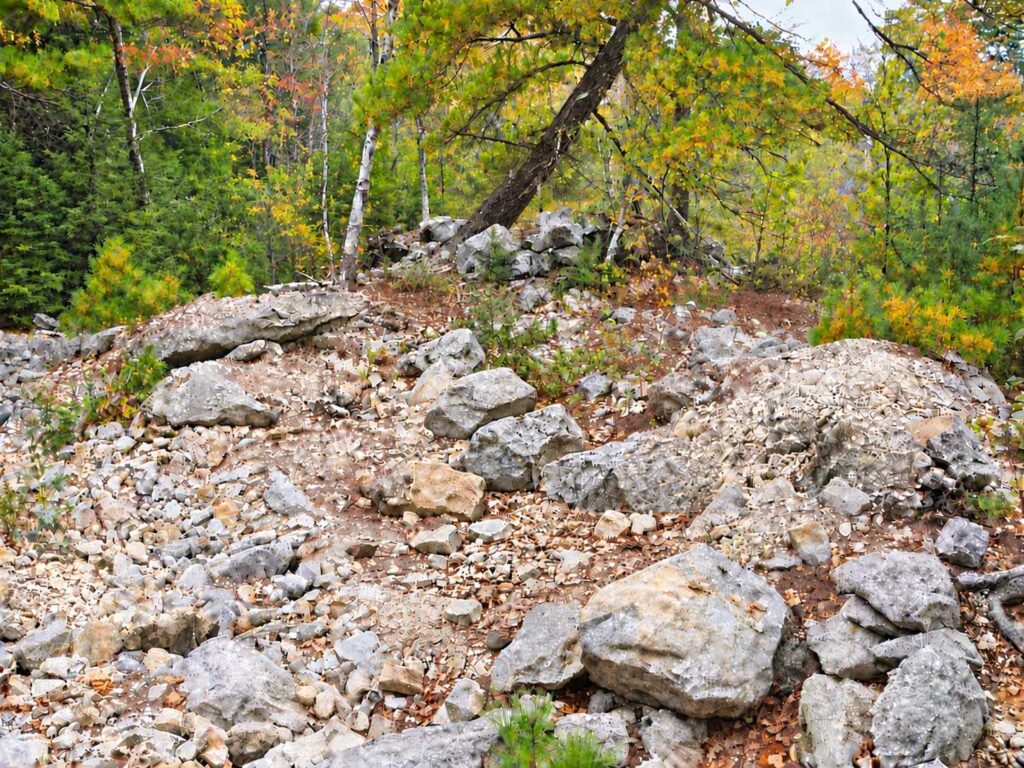
Recent Photo of Swamp Quarry
The broken rock in the foreground forms a waste-rock dump from the former feldspar quarry, where many uraninite crystals were discovered.
The water-filled quarry pit lies behind the rock dump.
Timeline of the Swamp Mine
Period |
Event |
| Mid-1800s | Commercial feldspar mining develops in the Topsham pegmatite district. |
| Late 1800s–early 1900s | Numerous small pegmatite workings develop; Swamp Mine appears to have originated as a small early-1900s feldspar quarry. |
| 1945 | Maine and U.S. Geological Surveys conduct a major investigation of the Topsham pegmatites. |
| 1948 | Vincent Shainin publishes Economic Geology of Some Pegmatites in Topsham, Maine; the Swamp pegmatite is mapped. |
| c. 1958 | 13-year-old Cliff Trebilcock Jr. discovers exceptional uraninite at Swamp #1. |
| Late 1950s–1960s | Quarry is drained and the Trebilcock family recovers numerous superb uraninite crystals. |
| 1960s–1990s | Swamp uraninite becomes increasingly famous among collectors while the exact source remains relatively closely held. |
| 1994 | Mineralogy of Maine, Vol. 1 documents Swamp Mine and its mineralogy; the locality becomes publicly established in the literature. |
| 1996 | Cliff Trebilcock and Don Swenson re-prospect Swamp Mine for uraninite. |
| 1997 | Scientific work reports chemical/isotopic analyses of Swamp Quarry uraninite, including an approximate 312 Ma Pb-isotope age. |
| 2000s–present | Original Trebilcock specimens become highly recognized historic collector pieces; Swamp Mine is widely regarded as a classic, world-class uraninite locality. |