
Radioactivity
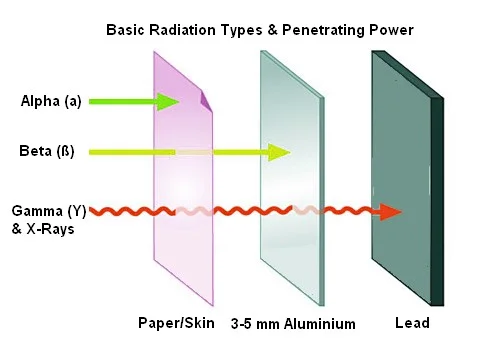
Radioactive minerals such as uraninite and thorite contain naturally occurring radioactive elements. Their isotopes and decay products undergo spontaneous radioactive decay, transforming into more stable nuclei and releasing ionizing radiation. Each type of radiation has distinct physical properties—some travel only a few centimeters in air, while others can penetrate the human body and substantial amounts of material.
The three principal types encountered with radioactive minerals are alpha (α), beta (β), and gamma (γ) radiation. Each has distinct physical properties, penetrating ability, shielding requirements, and potential health effects. The sections below explain how each type is produced and how it relates to the safe handling and storage of radioactive mineral specimens.
Radon gas, a radioactive decay product of uranium that presents a different consideration for mineral storage and ventilation.
Select a tab for the different types of radiation
Alpha Radiation (α)
Definition
Alpha radiation consists of alpha particles, which are helium-4 nuclei (42He2+). Each alpha particle contains two protons and two neutrons and has a +2 electrical charge. Because alpha particles are relatively massive and highly charged, they interact strongly with matter and lose their energy over very short distances.
Mineralogical & Everyday Sources
Alpha radiation is common in uranium- and thorium-bearing minerals. Examples include:
- Uraninite / Pitchblende (UO2)
- Thorite (ThSiO4)
- Americium-241 (241Am) — an artificial alpha-emitting isotope commonly used as the ionization source in household smoke detectors.
Penetration Power
Alpha particles have very little penetrating power. In air, a typical alpha particle travels only a few centimeters before losing its energy. When it eventually captures electrons, it becomes an ordinary helium atom.
Shielding
Because alpha particles have such a short range, very little material is required to stop them. They can be stopped by:
- A sheet of ordinary paper
- The dead outer layer of human skin
- Glass or acrylic used in mineral display cases
Safety
- External exposure: Alpha radiation generally presents little external hazard because alpha particles cannot penetrate the dead outer layer of intact skin.
- Internal exposure: Alpha-emitting material can present a significant hazard if radioactive dust or other material is inhaled or ingested. Alpha particles deposit their energy over an extremely short distance, producing intense ionization in nearby tissue. For radioactive minerals, avoiding inhalation or ingestion of dust is therefore particularly important.
Beta Radiation (β)
Definition
Beta radiation consists of beta particles, which are high-speed electrons (β−) or positrons (β+) emitted from an unstable atomic nucleus. In beta-minus decay, a neutron is transformed into a proton and an electron is emitted. In beta-plus decay, a proton is transformed into a neutron and a positron is emitted.
Beta particles have much less mass than alpha particles and carry a single electrical charge. As a result, they penetrate matter more deeply than alpha particles but are considerably less penetrating than gamma radiation.
Mineralogical Sources
Beta radiation is common in uranium- and thorium-bearing minerals because several radioactive daughter products in their natural decay chains undergo beta decay. A uranium mineral may therefore emit beta radiation even though the uranium isotopes themselves decay primarily by alpha emission.
Examples of uranium-bearing minerals that may contain these radioactive decay products include:
- Uraninite / Pitchblende (UO2)
- Autunite (Ca(UO2)2(PO4)2·10–12H2O)
- Carnotite (K2(UO2)2(VO4)2·3H2O)
Penetration Power
Because beta particles are much lighter than alpha particles and carry only a single charge, they generally travel farther through matter. Depending on their energy, beta particles may travel from a few centimeters to several meters in air and can penetrate the outer layers of skin.
Shielding
Beta radiation is effectively shielded by relatively thin layers of low-density material. Common shielding materials include:
- Plastic or acrylic
- Thin sheets of aluminum
Dense materials such as lead are generally not preferred as the first layer of beta shielding. When energetic beta particles are rapidly slowed in a high-density material, they can produce secondary X-rays known as bremsstrahlung. For this reason, plastic or acrylic is commonly used to stop the beta particles first.
Safety
- External exposure: Beta particles can penetrate the outer layers of skin. Prolonged or close exposure to sufficiently strong beta sources can therefore damage living tissue.
- Internal exposure: Beta-emitting radioactive material can present a significant hazard if inhaled or ingested because the emitted particles deposit their energy directly in surrounding tissue. Avoiding radioactive mineral dust is therefore particularly important.
Gamma Radiation (γ)
Definition
Gamma radiation consists of gamma rays, which are high-energy electromagnetic photons emitted from an atomic nucleus. Unlike alpha and beta particles, gamma rays have no mass and no electrical charge.
Gamma radiation is often emitted after an alpha or beta decay leaves the daughter nucleus in an excited energy state. The nucleus releases this excess energy as one or more gamma photons as it transitions to a lower-energy state.
Mineralogical Sources
Gamma radiation from uranium- and thorium-bearing minerals is produced largely by radioactive daughter products within their natural decay chains. Some of these daughter isotopes emit characteristic gamma rays as they decay.
In uraninite, important gamma-emitting daughter products include lead-214 (214Pb) and bismuth-214 (214Bi). These are part of the uranium-238 decay series and contribute significantly to the gamma radiation that can be detected from a uranium mineral specimen.
Uranium-bearing minerals that may produce measurable gamma radiation include:
- Uraninite / Pitchblende (UO2)
- Autunite (Ca(UO2)2(PO4)2·10–12H2O)
- Carnotite (K2(UO2)2(VO4)2·3H2O)
Penetration Power
Because gamma rays have no mass or electrical charge, they interact with matter differently from alpha and beta particles and are much more penetrating. Gamma rays can travel considerable distances through air and can pass through the human body. Their intensity gradually decreases as they interact with matter and as distance from the source increases.
Shielding
Gamma radiation cannot normally be stopped completely with practical shielding. Instead, shielding is used to attenuate the radiation, reducing its intensity. Dense materials are particularly effective. Common gamma shielding materials include:
- Thick lead
- Steel or cast iron
- Thick concrete
- Dense earth or masonry
The amount of shielding required depends on the energy of the gamma rays and the degree of attenuation desired.
Safety
- External exposure: Gamma radiation is the principal penetrating external radiation concern associated with uranium mineral specimens. Gamma rays readily pass through ordinary plastic containers, display glass, and the outer layers of the body. Exposure can be reduced by limiting time near a source, increasing distance, and using appropriate shielding when necessary.
- Internal exposure: Gamma-emitting radioactive material can also present an internal hazard if inhaled or ingested.
Radon Gas
Formation of Radon-222
Radon-222 (222Rn) is a naturally occurring radioactive noble gas produced in the uranium-238 decay series. It forms when radium-226 undergoes alpha decay:
226Ra → 222Rn + α
Radium-226 is present in uranium-bearing minerals as a product of the uranium-238 decay chain. Because radon is a gas rather than a solid, some of the radon atoms formed within a mineral can escape into the surrounding air. This process is known as radon emanation.
The fraction that escapes depends on the mineral’s physical structure, including fractures, porosity, grain size, and the location where individual radon atoms are produced.
Consequently, uraninite not only emits alpha, beta, and gamma radiation through its radioactive decay chains but also continuously generates radon-222.
Radioactive Decay of Radon
Radon-222 has a half-life of approximately 3.82 days. It decays by alpha emission to polonium-218, initiating a sequence of short-lived radioactive products known as radon progeny, historically called radon daughters.
The principal stages of this sequence are shown below.
| Isotope | Primary Radiation | Half-Life |
|---|---|---|
| Radium-226 | Alpha (α) | 1,600 years |
| Radon-222 (gas) | Alpha (α) | 3.82 days |
| Polonium-218 | Alpha (α) | 3.10 minutes |
| Lead-214 | Beta (β), gamma (γ) | 26.8 minutes |
| Bismuth-214 | Beta (β), gamma (γ) | 19.9 minutes |
| Polonium-214 | Alpha (α) | 164 microseconds |
| Lead-210 | Beta (β) | 22.3 years |
| Bismuth-210 | Beta (β) | 5.01 days |
| Polonium-210 | Alpha (α) | 138.4 days |
| Lead-206 (stable) | None | Stable |
The decay sequence ends when it reaches stable lead-206.
Radon Progeny and Radiation Exposure
Unlike radon, its decay products are not gases under ordinary environmental conditions. Newly formed progeny may remain suspended in air as individual atoms or ions, attach to microscopic airborne particles, or deposit on nearby surfaces.
When radon progeny are inhaled, some can deposit in the respiratory tract. Their subsequent radioactive decay exposes nearby tissue to ionizing radiation, particularly alpha particles.
The principal health concern from radon exposure is the inhalation of radon and its radioactive progeny, which increases the long-term risk of lung cancer.
Radon progeny can also accumulate on the interior surfaces of containers holding uranium-bearing minerals. Some longer-lived products, particularly lead-210, can remain on these surfaces long after the original radon has decayed.
Radon in Mineral Collections
Uraninite specimens continuously produce radon-222 as radium-226 within the mineral decays. The amount released into the surrounding environment depends on the quantity of radioactive material, the mineral’s physical characteristics, and the conditions under which specimens are stored.
For collectors, several practical considerations are important:
- Ventilation: Store significant quantities of uranium-bearing minerals in locations with adequate air exchange, preferably away from frequently occupied living areas.
- Sealed containers: Tightly closed containers can limit radon release into the surrounding environment. However, radon and its radioactive progeny can accumulate inside the containers over time.
- Opening containers: Open containers holding radioactive minerals in a well-ventilated area, preferably outdoors. Although the gas volume is small, the concentration inside a sealed container can be substantially higher than in the surrounding air. Avoid breathing directly over the opening.
- Surface contamination: Radon progeny may deposit on container interiors and specimen surfaces. Avoid unnecessary contact with potentially contaminated surfaces, and wash hands after handling specimens.
- Dust control: Avoid grinding, brushing aggressively, or otherwise generating airborne mineral particles.
- Radon monitoring: A continuous electronic radon monitor can help evaluate concentrations in storage areas. Long-term averages are more useful than individual readings because radon concentrations fluctuate with ventilation and environmental conditions.
Radon Concentration and EPA Guidance
Radon concentrations in the United States are commonly expressed in picocuries per liter (pCi/L), a measure of radioactive activity per unit volume of air.
The U.S. Environmental Protection Agency recommends corrective action when the long-term average indoor radon concentration reaches 4.0 pCi/L, and consideration of corrective action at concentrations between 2.0 and 4.0 pCi/L.
No level of radon exposure is considered completely without risk. Reducing unnecessary exposure is therefore a reasonable precaution when storing or handling uranium-bearing mineral specimens. [9]