
Uraninum
Uranium is a naturally occurring radioactive element found in small amounts throughout Earth’s crust. Uraninite is the principal ore mineral of uranium and consists primarily of uranium oxides. The uraninite crystals found at Swamp Quarry #1 are composed primarily of uranium dioxide (UO₂).
Select a section
Uranium Decay Chain
Introduction
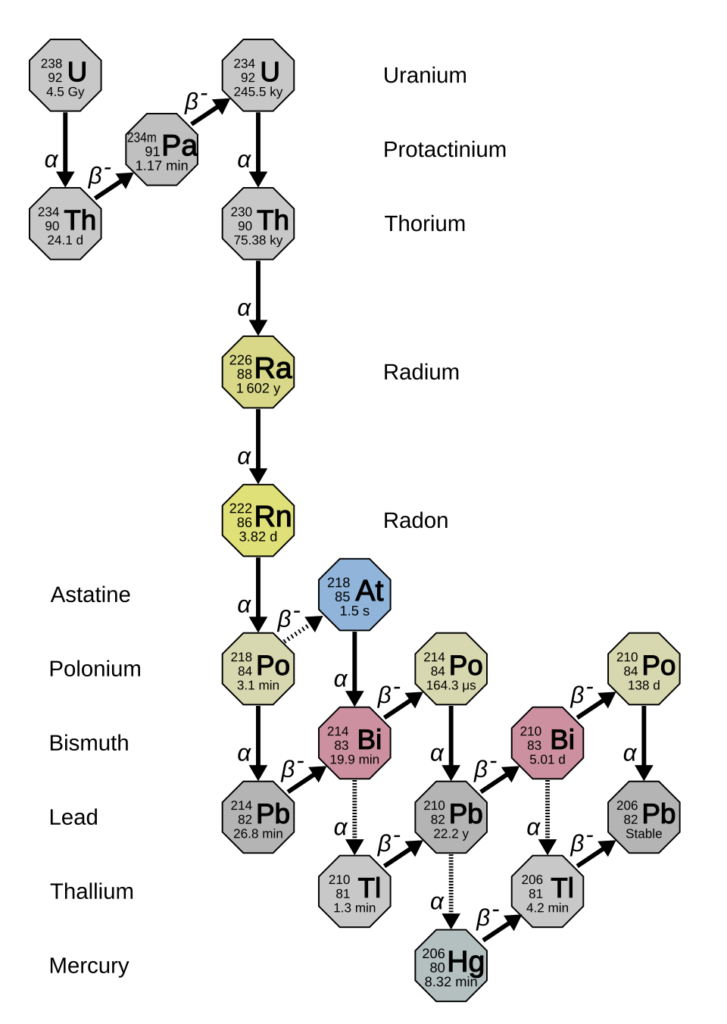
The uranium decay chain is a sequential series of nuclear transformations by which unstable, radioactive uranium stabilizes into a non-radioactive element. In nature, this process primarily begins with Uranium-238 (²³⁸U), the most abundant isotope of uranium found in the Earth’s crust.
Because uranium has an unstable nucleus, it continuously sheds excess energy and mass through a process called radioactive decay. It cannot achieve stability in a single step. Instead, it undergoes a cascade of transformations—transmuting into various unstable “daughter” elements like thorium, radium, and radon—before finally reaching a permanent, stable state as Lead-206 (²⁰⁶Pb).
This entire sequence is known as the uranium series or the radium series, and understanding it is critical for fields ranging from geological dating to radiation safety and mining.
Understanding the Decay Chain
The uranium-238 decay chain is a sequence of nuclear transformations in which one radioactive nuclide changes into another. The original radioactive nuclide is called the parent, and the nuclide produced by its decay is called the daughter. Many daughter products are themselves radioactive, so the process continues through a series of transformations until a stable nucleus is reached.
Alpha decay (α) occurs when an unstable nucleus emits an alpha particle consisting of two protons and two neutrons—the nucleus of a helium-4 atom. Because two protons are lost, the atomic number decreases by 2, while the mass number decreases by 4. For example, uranium-238 undergoes alpha decay to form thorium-234:
²³⁸U → ²³⁴Th + ⁴He
Beta-minus decay (β⁻) occurs when a neutron in the nucleus is transformed into a proton, with the emission of an electron and an antineutrino. The mass number remains unchanged, but the atomic number increases by 1. An example in the uranium-238 series is the decay of thorium-234 to protactinium-234:
²³⁴Th → ²³⁴Pa + β⁻ + ν̅ₑ
Gamma radiation (γ) is different from alpha and beta decay because gamma emission does not change one element into another. Following a nuclear transformation, a daughter nucleus may be left in an excited energy state. The nucleus can then release this excess energy as a gamma-ray photon and drop to a lower-energy state. Its atomic number and mass number remain unchanged.
Each radioactive member of the chain has a characteristic half-life, ranging from billions of years for uranium-238 to fractions of a second for some short-lived daughter products. The different half-lives shown in the diagram indicate how long, on average, each radionuclide persists before undergoing further radioactive decay.
The uranium-238 series eventually terminates at lead-206 (²⁰⁶Pb), which is stable. Thus, uranium atoms incorporated into uraninite hundreds of millions of years ago have continuously produced a succession of radioactive daughter products and, ultimately, radiogenic lead.
Gamma Spectrum
Uranium Ore Gamma Spectrum
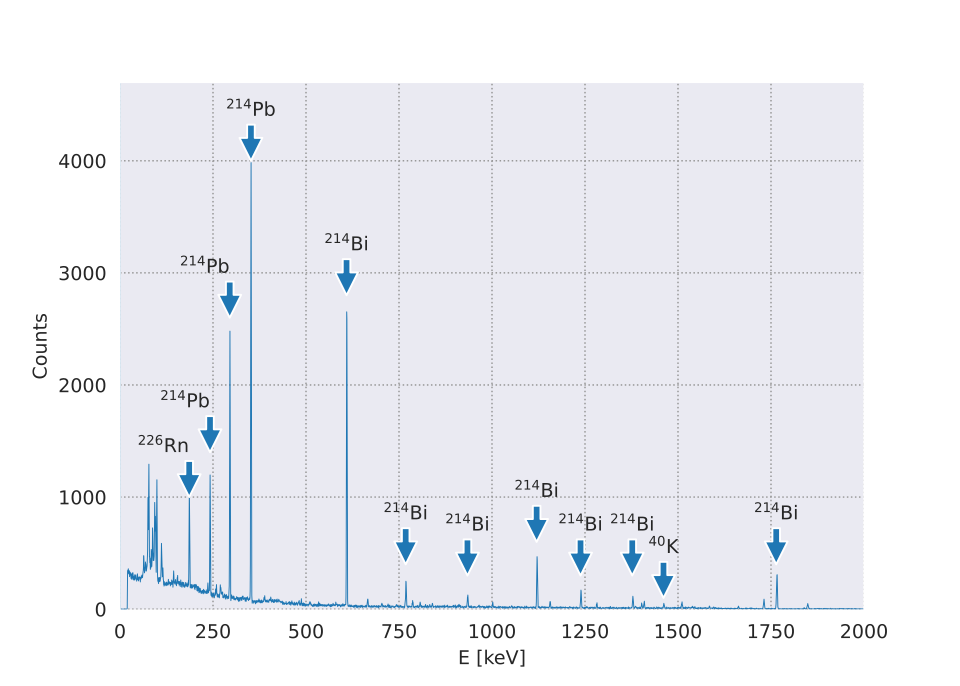
The graph shows the gamma-ray energy spectrum of a natural uranium ore sample from Moab, Utah.
Each prominent peak represents gamma rays detected at a characteristic energy.
Many of the labeled peaks originate from radioactive daughter products in the uranium-238 decay series, particularly lead-214 and bismuth-214.
The spectrum provides a useful visual example of how gamma-ray energies can be used to identify radionuclides in uranium-bearing minerals.
Understanding the Gamma Spectrum
A gamma-ray spectrum provides a characteristic picture of the gamma radiation emitted by a radioactive material. The horizontal axis represents gamma-ray energy, measured in kiloelectronvolts (keV), while the vertical axis represents the number of detected gamma rays at each energy.
Rather than producing gamma rays at every possible energy, radioactive nuclei emit gamma rays at specific energies determined by their nuclear structure. These emissions appear in a spectrum as photopeaks. The energies of these peaks can therefore be used to identify the radionuclides present in a sample.
Uranium ore produces a particularly complex spectrum because naturally occurring uranium is accompanied by a series of radioactive daughter products.
The Uranium-238 Decay Series
Uranium-238 itself is not responsible for most of the prominent gamma-ray peaks observed in uranium ore. As 238U decays through its long sequence of daughter products, several of those radionuclides emit readily detectable gamma rays.
Among the most important are radium-226 (226Ra), lead-214 (214Pb), and bismuth-214 (214Bi).
Prominent features include gamma-ray energies near:
- 186 keV — associated with 226Ra, although this region can also contain a contribution from 235U.
- 242, 295, and 352 keV — characteristic emissions from 214Pb.
- 609, 1120, and 1764 keV — prominent emissions from 214Bi.
- 1461 keV — 40K (potassium-40), a naturally occurring environmental radionuclide that is not part of the uranium decay series.
The presence of numerous daughter-product peaks is one reason gamma spectroscopy is so useful for examining uranium-bearing minerals. Instead of detecting only the parent uranium, the spectrum reveals emissions produced throughout its radioactive decay chain.
Sharp Peaks
The spectrum shown here is a carefully processed gamma-ray spectrum in which the principal photopeaks have been clearly resolved and labeled. This makes it particularly useful for identifying the characteristic gamma-ray energies associated with uranium and its decay products.
The narrow appearance of the plotted peaks should not, by itself, be interpreted as a direct measure of detector resolution. Gamma spectra obtained with different instruments can look substantially different. Portable scintillation spectrometers used by mineral collectors (e.g.,Radiacode) may display the same characteristic gamma-ray energies as broader, less clearly separated peaks.
The nuclear energies do not change—the difference is in how precisely the detector and its electronics can distinguish and display them.
The Compton Continuum
Not every gamma ray deposits all of its energy in the detector. Some gamma rays undergo Compton scattering, transferring only part of their energy before escaping.
These partial-energy interactions produce the broad background beneath and between the photopeaks, known as the Compton continuum.
A photopeak therefore represents gamma rays that deposited essentially their full energy in the detector, while the surrounding continuum contains many events in which only part of the original gamma-ray energy was recorded.
What the Spectrum Reveals
A gamma spectrum provides much more information than a simple radiation count. A Geiger counter can indicate that a specimen is radioactive, but it generally cannot determine which radionuclides produced the radiation.
Gamma spectroscopy adds an energy dimension to the measurement. By comparing measured photopeak energies with known nuclear gamma-ray energies, individual radionuclides can be identified.
For uranium minerals such as uraninite, the result is effectively a “nuclear fingerprint”—a pattern of gamma-ray energies produced by uranium and the radioactive descendants generated during billions of years of natural decay.
Crystal Dating
The 312-Million-Year-Old Uraninite of Swamp Quarry
The uraninite crystals from Swamp Quarry are extraordinarily old. Scientific analysis of the uranium and lead preserved within the crystals indicates that they formed approximately 312 million years ago [4].
That places their formation in the Carboniferous Period, when vast forests covered much of the land and long before the first dinosaurs appeared.
The quarry, the miners, and even the rocks exposed at the surface today are only the most recent chapter in a geological story that began more than 300 million years ago.
How the Uraninite Crystals Formed
The Swamp Quarry uraninite did not begin as molten UO₂, nor was it produced directly by a volcanic eruption.
Instead, the crystals formed deep underground within a granitic pegmatite. Late in the crystallization of the granite, extremely hot, water-rich fluids containing dissolved uranium and other elements moved through openings and fractures in the pegmatite.
As these fluids cooled and their chemistry changed, uranium became concentrated and uranium oxide crystallized as uraninite (UO₂).
The uranium atoms became locked into the growing crystal structure. The sharp crystal faces visible on many Swamp Quarry specimens are the external expression of this orderly atomic structure.
At that moment—about 312 million years ago—the uraninite crystal had formed.
And something remarkable began.
A Natural Radioactive Clock
Uraninite is naturally radioactive because its uranium atoms are unstable. Over immense periods of time, uranium-238 and uranium-235 undergo a series of radioactive decays that ultimately produce stable isotopes of lead (Pb). This lead is called radiogenic lead because it was produced by radioactive decay.
When the Swamp Quarry uraninite crystals formed about 312 million years ago, the geological clock started. From that moment forward, uranium atoms within the crystals slowly decayed, while radiogenic lead accumulated.
This is the key to the dating process: the amount of uranium remaining and the amount of radiogenic lead produced are related by precisely known radioactive decay rates. By measuring these uranium and lead isotopes in the uraninite today, scientists can calculate how much time has passed since the crystal formed.
In effect, each uraninite crystal contains its own natural clock—one that has been running for about 312 million years.
The uranium–lead dating process is explained in more detail below.
Two Independent Uranium Clocks
Natural uranium contains two important radioactive isotopes:
Uranium-238 → Lead-206
and
Uranium-235 → Lead-207
Each uranium isotope decays at its own precisely known rate. Uranium-238 has a half-life of about 4.47 billion years, while uranium-235 has a half-life of about 704 million years.
Because the two decay systems operate simultaneously within the same uraninite crystal, they provide an especially powerful method for determining geological age.
Scientists analyzed Swamp Quarry uraninite and measured the radiogenic lead isotopes produced by these decay processes. The reported ²⁰⁷Pb/²⁰⁶Pb ratio was 0.0526, corresponding to an age of approximately 312 million years [4].
The lead is therefore not simply an impurity in the uraninite. Much of it is radiogenic lead—the accumulated end product of hundreds of millions of years of uranium decay.
What Does 312 Million Years Mean?
An age of 312 Ma means 312 million years before the present.
At that time, Earth was in the late Carboniferous Period. Extensive forests and wetlands existed across large parts of the continents. These ancient environments eventually contributed to many of the world’s major coal deposits.
The dinosaurs had not yet appeared. The earliest dinosaurs would not evolve until roughly 80 million years later.
So when dinosaurs eventually walked the Earth, the Swamp Quarry uraninite crystals were already tens of millions of years old—and their internal uranium clocks were already running.
The crystals remained locked within the Maine pegmatite for hundreds of millions of years before quarrying finally exposed them during the comparatively tiny interval of human history.
Calculation — How the 312 Ma Age Is Obtained
The measured ratio of radiogenic lead isotopes provides the clock:
²⁰⁷Pb / ²⁰⁶Pb = 0.0526
Lead-207 is the final stable product of the uranium-235 decay series, while lead-206 is the final stable product of the uranium-238 decay series.
Because the decay rates of both uranium isotopes are known, their daughter lead-isotope ratio changes predictably with time.
The relationship can be written as:

where:
137.88 = approximate present-day ratio of ²³⁸U to ²³⁵U
λ₂₃₅ = decay constant of uranium-235
λ₂₃₈ = decay constant of uranium-238
t = time since the uraninite crystallized
Using the measured Swamp Quarry value:
²⁰⁷Pb / ²⁰⁶Pb = 0.0526
We solve the equation for t, the time since the uraninite crystallized. The result is:
t ≈ 3.12 × 10⁸ years
or approximately:
≈ 312 million years
That number represents the approximate time when uranium became incorporated into the newly formed uraninite crystal and its uranium–lead geological clock began to run. [4]